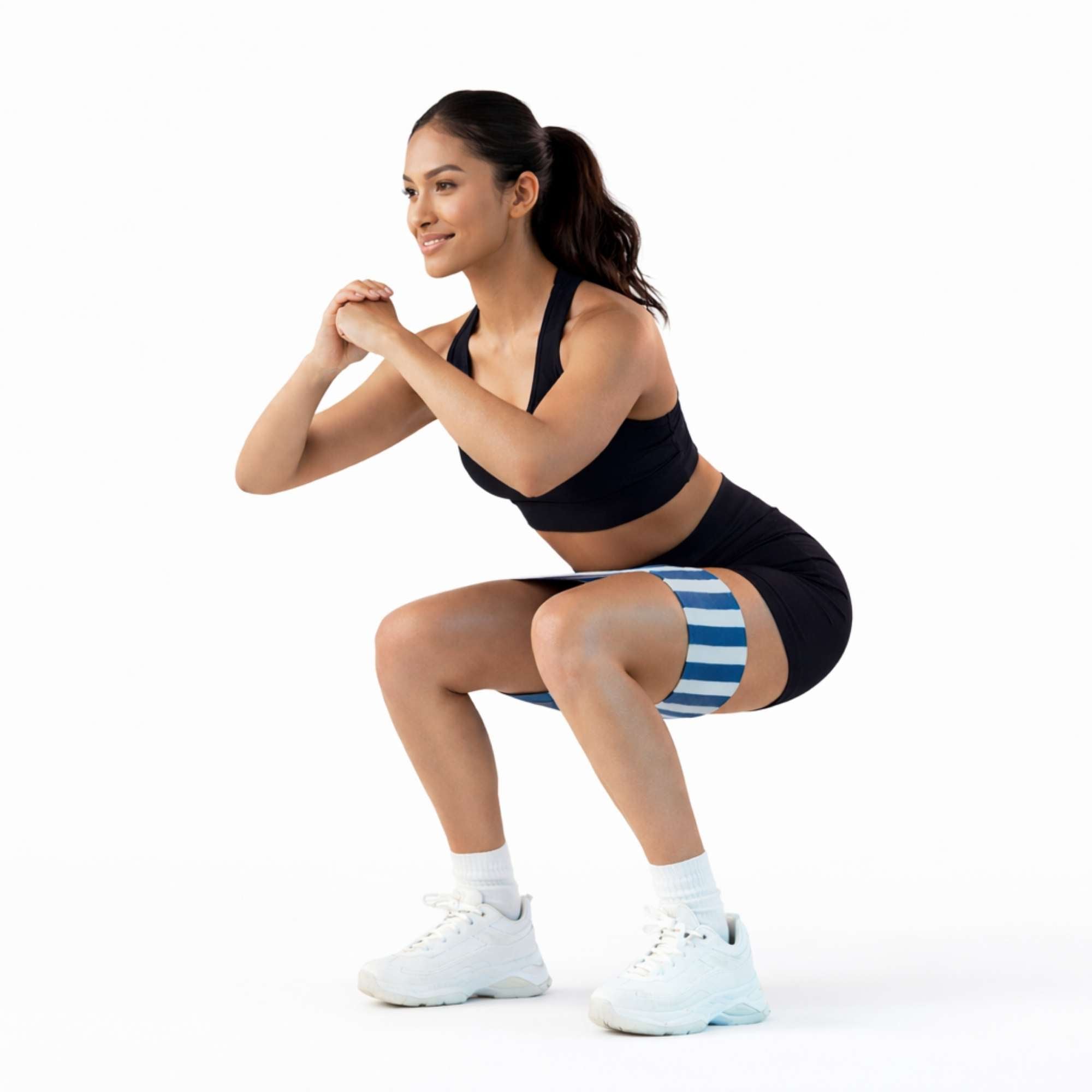

At first glance, they look similar.
Same format.
Same function.
The same promise of resistance.
Yet their behavior during training is fundamentally different.
And it is not a matter of upper body versus lower body.
It is a matter of internal structure and mechanical response to tension.
1. What is commonly called a “latex band”
Composition
Generally made from natural latex (rubber).
A homogeneous, thin, continuous structure.
Mechanical properties
- High elasticity
- Very progressive resistance
- Strong elongation capacity
- The more it stretches, the more the tension increases significantly.
Training sensation
- Responsive feedback
- Precise work through a full range of motion
- Fast activation of stabilizing muscles
Ideal for
- Shoulder work
- Arms and back
- Deep activation in Pilates
- Dynamic mobility
- Fluid exercise sequences
2. What is commonly called a “fabric band”
Contrary to a common belief, most bands referred to as “fabric bands” are not latex-free.
Actual composition
They are often made of:
- Latex or internal elastic threads
- Polyester
- Elastane
Mechanical properties
- More controlled elasticity
- More stable resistance
- Lower maximum elongation
The tension increases less abruptly than with a 100% latex band.
Training sensation
- Soft contact on the skin
- More “anchored” band
- Less rolling during exercises
- Greater stability
And contrary to some assumptions, it can be used for both upper and lower body, especially in mini-loop format.
3. The real difference: the resistance curve
This is where the fundamental distinction lies.
Pure latex
→ Highly progressive resistance curve
→ The larger the range of motion, the more the tension increases dramatically
Fabric band
→ More linear resistance curve
→ More constant resistance over time
This influences:
- Muscular fatigue
- Burning sensation
- Eccentric control
- Type of muscle fibers recruited
4. Comfort and stability
| Criterion | Pure latex | Fabric band |
|---|---|---|
| Skin contact | Can roll | Stable |
| Sensation | Dynamic | Controlled |
| Maximum range | Very high | Medium to high |
| Versatility | Very wide | Very wide |
| Comfort on thighs | Moderate | Excellent |
5. Which choice for which objective?
If you are looking for:
- Large range of motion
- Technical and precise work
- Responsive sensation
- Deep muscle activation
→ Pure latex
If you are looking for:
- Comfort
- Stability
- Controlled tension
- Slow, controlled training
→ Fabric band
But in a structured training approach, both complement each other.
Latex for activation and mobility.
Fabric for controlled intensity and time under tension.
6. The elegance of movement does not depend on the material
What transforms the body over time is not the band itself.
It is:
- Slowness
- Control
- Alignment
- Consistency
The material influences the sensation.
Technique influences the result.
Choosing consciously simply allows the body to be trained with greater intelligence.